
Teaching Case: Lunar Bank - Solving the Innovation Paradox in the Nordic Banking Industry
A Case Study by Darius-Aurel Frank & Werner Kunz
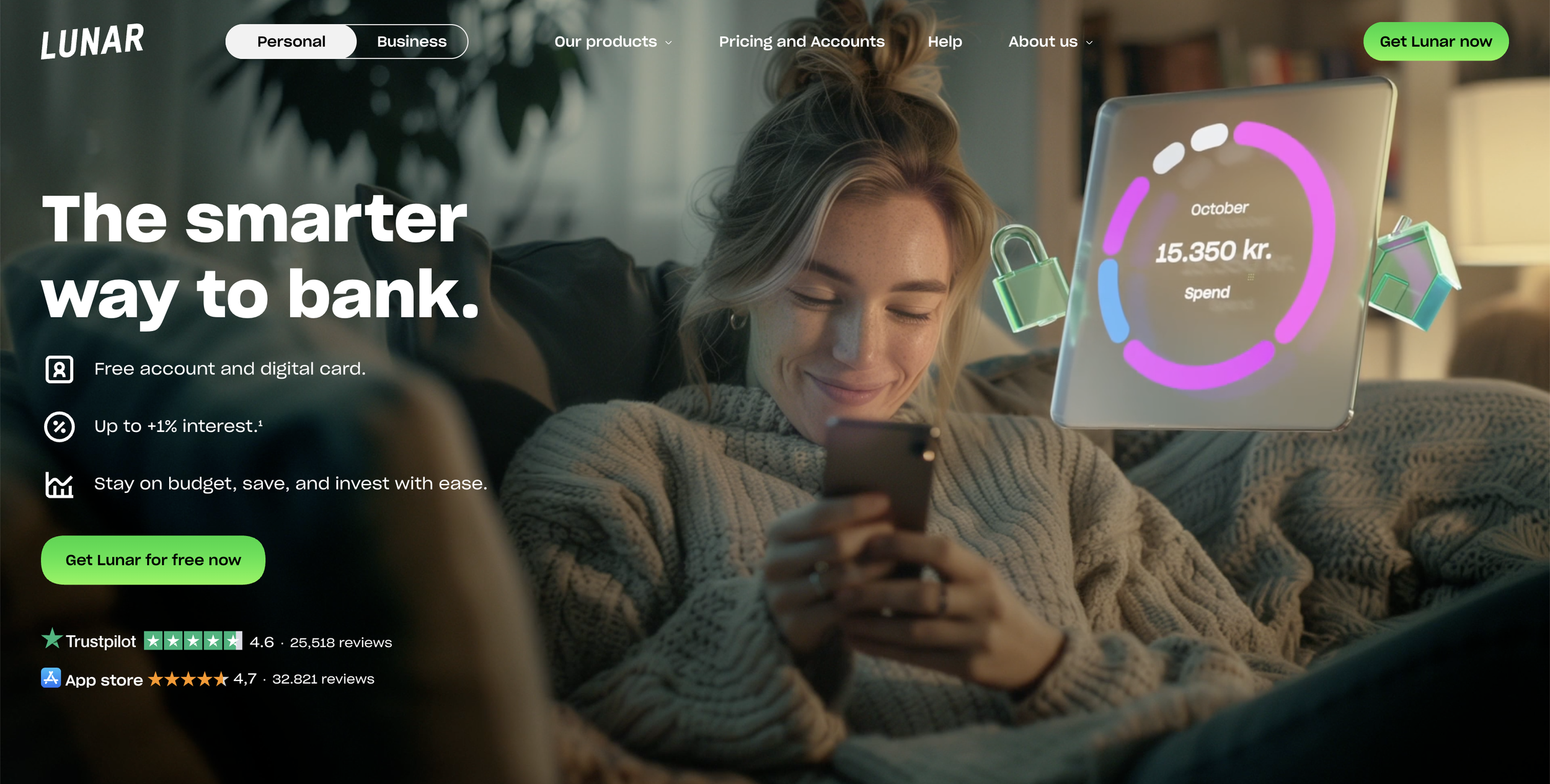
“The smarter way to bank” is how Lunar Bank positions itself in the Nordic banking industry.
Ken Villum Klausen, founder and CEO of Lunar, has spent the past decade on reshaping an entire industry; but what should banking look like in a future dominated by digital and AI technology? From Denmark, he built Lunar into a fintech serving more than one million customers across the Nordic region, challenging a market long dominated by incumbents such as Danske Bank, Nordea, and Jyske Bank. Where traditional banks relied on scale, legacy, and routine, Ken pushed a vision built on simplicity, utility, and a fundamentally new customer experience. Under his leadership, Lunar grew from a startup into one of the region’s most closely watched digital banking platforms.
Late in the afternoon at Lunar’s headquarters in Aarhus, Ken Villum Klausen sat in front of his screen ready to address a question that was both simple, imminent and widely unsettling: what should banking become in a future?
For more than a decade, he has worked to challenge the logic of Nordic banking. The old banks had scale, trust, capital, and habit on their side. Lunar has speed, clarity, and a conviction that everyday banking did not need to feel slow, opaque, or institutional. What began in 2015 as a digital challenger has grown into a bank serving more than one million users across the Nordics, backed by major investors and built around an app-first model rather than legacy systems and inherited convictions.
Ken shared his vision in a LinkedIn post:
“The future of banking is invisible. At Lunar, we believe the best banking experience is no experience at all. Because let’s be honest: no matter how slick an app looks, paying bills, checking statements, or moving money is still boring. It’s friction. It’s wasted time. In the future, we believe that will be seen not as a sign of success, but as a sign of inefficiency. The less you need to use your banking app, the better. This is where we differ from both incumbents and most challenger banks. Where others celebrate “engagement,” we see distraction. Banking shouldn’t fight for your attention—it should remove the need for it. The real goal? A full-scale financial agent. One that quietly solves problems, keeps your finances healthy, and works so smoothly you forget it’s even there. We don’t need more banking apps. We need banking that’s automated, intelligent, and invisible. That’s the future we’re building.”
His vision was bold, radical, and its implications as unsettling as asking the question. His business had built its reputation around being the challenger that is making change visible: a better interface, a clearer service logic, a more modern tone, smarter support, and fewer frictions. But what happens when the next iteration of technology makes the service less, rather than more, visible?
Ken knew, Lunar had already begun to move in that direction. The company has introduced AI-enabled service support at scale, with more than 70 percent of written customer inquiries reportedly handled fully by AI in 2024 and 85 percent of support cases resolved without human intervention in 2025.
For too many executives, he argues, those numbers would be proof of efficiency. To him, they pointed toward something much bigger: the best banking experience would not be one that maximized engagement, but one that quietly removed friction, solved problems in the background, and reduced the need for customers to open the app at all. Banking in this novel paradigm will become automated, intelligent, and almost forgettable.
Time will tell, if this new strategy was the right move into the future of digital banking. For now, all he knows is where they came from.
THE RISE OF LUNAR IN THE NORDICS
Ken knew Lunar’s rise was not simply a story about technology. The large incumbent banks in Denmark had not ignored digitalization. They had invested heavily in infrastructure, security, and online access. They operated in one of the most digitally advanced societies in Europe, where citizens were accustomed to digital IDs, cashless payments, and seamless online public services. Yet for many customers, those banks still felt like institutions built to preserve the category rather than reinvent it. They were reliable, but rarely surprising. Competent, but not exciting. In a market long dominated by a small group of large banks, where customers had little reason to switch and where trust in established institutions ran high, he had found an opening: not by offering “more banking,” but by reimagining what banking should feel like in everyday life.
That insight had shaped Lunar’s identity. The company presented itself as free of legacy infrastructure, built around convenience, transparency, and control. In Lunar’s world, checking balances, managing cards, budgeting, receiving support, and moving money were not minor touchpoints. They were the product. Ken believed that if banking was something people had to endure, then the problem was not the customer’s attitude; the problem was the design of the service. Lunar, therefore, positioned itself not merely as a digital version of a traditional bank, but as a different philosophy of banking altogether: flexible, immediate, and centered on customers' daily reality. Just a smarter way to bank.
Exhibit 1. The Danish Banking Industry
-
The Danish banking industry has historically been concentrated, with a small number of large incumbent institutions, including Danske Bank, Nordea, and Jyske Bank, holding strong market positions.
-
The industry operates in a context characterized by high institutional trust, including trust in public systems and established financial providers.
-
Danish consumers are accustomed to extensive digitalization across both public and private services, including digital identification systems and widespread cashless payments.
-
Customer mobility across banks has traditionally been limited, in part because many providers were perceived as offering relatively similar core services.
-
Incumbent banks have generally operated according to a relationship-based service logic, in which performance was associated with reliability, security, compliance, and uninterrupted service delivery.
-
In response to consumer expectations for digital services, incumbent banks have invested heavily in digital infrastructure, with particular focus on modernizing legacy systems, online communication, and addressing digital security risks.
-
Over the past decade, fintech entrants have altered the competitive landscape by introducing more app-based, low-friction service models, including freemium offerings and a stronger emphasis on everyday financial utility.
This positioning has been working. Lunar has expanded beyond Denmark into Sweden and Norway, built offices in Copenhagen and Stockholm alongside Aarhus, and increased its net fee income as more users. Recently, Lunar’s user count broke a new record of more than one million customers (see Exhibit 2). At the same time, net fee income, which includes revenue from a tiered premium subscription service, increased from 7.1 Mil. DKK in 2020 to 247.7 Mil. DKK in 2024.
Exhibit 2. User Acquisition Performance, Lunar Bank (2021–2025)
THE SECRET TO LUNAR’S SUCCESS?
But while he was reflecting on his vision for the company, he learned about an Innovation Index conducted by a nearby business school. The basic philosophy of this index is that the number of service innovations doesn’t equal firm innovativeness (see Exhibit 3). Therefore, the index measures firm innovativeness directly from the customer point of view.
Exhibit 3. Service Innovation vs. Firm Innovativeness
-
Firm innovativeness refers to consumers’ perception that a company is creative, progressive, future-oriented, and capable of changing the direction of the category. This distinction offers a new perspective as customers consider not only what a firm currently offers, but also to what they think the firm stands for and what they expect it to do in the future. It suggests that a company could be perceived as innovative not only when it introduces new features but rather challenges conventions and represents itself as driver of the future direction of the category [1].
-
Service innovation refers to new and meaningful changes in the offering, the process, the user interaction, and the systems through which value is created and delivered. In banking, this includes changes such as new budgeting tools, automated saving routines, online security protections, and new ways for customers to carry out everyday transactions, such as tap-to-pay. These innovations do not all work in the same way. Some directly improve the customer experience by making banking easier, faster, or more convenient. Others operate more in the background by reducing hassle, increasing reliability, or making banking more fail-safe. This also means that some service innovations could be more visible and affect customers in a greater way than others.
The index showed him a striking pattern in the Danish banking industry (see Exhibit 4): Incumbents and Lunar scored almost identically on measures of Perceived Digital Innovativeness (PDI), a measure of the extent to which consumers perceive a company’s products, services, processes, or business models being enabled by digital information technology [2]. Hence, it seemed customers recognized that traditional banks were also using advanced digital technology, and that digital innovation efforts could not be the reason for their previous success.
But where Lunar Bank really outperformed the competition was in a second measure, Perceived Firm Innovativeness (PFI), a scale by which customers see the company as more future-oriented, more creative, and more capable of changing the market itself [1]. In fact, Lunar scores more than 10 index points higher than incumbents on this measure. Thus, these numbers revealed an Innovation Paradox. Although all banks invest similarly into digital innovations, and the customer has recognized that, only one company (i.e., Lunar) is seen as innovative and can clearly benefit from this investment.
But what did it mean for the future of Lunar Bank? Could this have been the real battleground (i.e., being seen as innovative)? Was Lunar not winning because it had a world-class mobile app, but rather because customers saw it as representing where banking was going? Did this belief make Lunar larger than its feature set and turn it into a symbol of progress in a category that customers had long perceived as static?
Exhibit 4 Banking Industry Performance, Denmark (2022–2025)
THE FUTURE OF NORDIC BANKING?
Ken left that day’s lunch with a problem sitting in front of him: Lunar had built its success by being noticed as being different. It had become the bank that customers talked about when they talked about the future. But his own vision implied a world in which the best bank might be the one that customers barely see. But if banking became truly invisible, wouldn’t Lunar be weakening the very perception that had fueled its rise? How could his company remain the innovation leader if its best innovations disappeared into the background? Could “no experience at all” become the ultimate premium service? Or would invisibility hand the symbolic advantage back to competitors who traditionally have more visible customer interaction?
He looked at the problem less as a founder protecting a business model and more as someone trying to define the next logic of an industry. Lunar had won the innovation game once: while traditional banks had spent years optimizing reliability and investing in digital innovation, Lunar had proven that banking could feel like change and had become the innovation leader in the eyes of the customer.
But Ken now realized that the next challenge was harder: designing a form of banking that customers trusted, valued, and perhaps even admired precisely because it demanded so little of their attention. That this was not just a technology decision alone, but a service design problem, a strategic communication problem, and a category-definition problem at the same time [3].
If he was right, then the future of banking would not be built around more screens, more touchpoints, or more “engagement.” It would be built around fewer interruptions, fewer decisions, and less visible effort. The question Ken could not avoid was whether Lunar could lead that future without vanishing inside it.
-
Kunz, W., Schmitt, B., & Meyer, A. (2011). How does perceived firm innovativeness affect the consumer? Journal of Business Research, 64(8), 816–822
Kurtmollaiev, S., Lervik-Olsen, L., & Andreassen, T. W. (2023). The Norwegian Innovation Index: Methodological Foundations. SNF Report No. 01/23. Bergen: Centre for Applied Research at NHH
Wirtz, J., Bateson, J. E., Čaić, M., Frank, D.-A., & Veflen, N. (2025). The healthy aging and service firms: the promise of smart technologies. Journal of Service Management.